In honor of Women’s History Month
For generations, the story of military service has centered on men. The son who leaves. The father who deploys. The soldier who goes to war.
But women have always served.
They have deployed. They have led. They have fought. They have carried the same weight, and sometimes more, while often fighting a second battle at home and a third battle in the VA system.
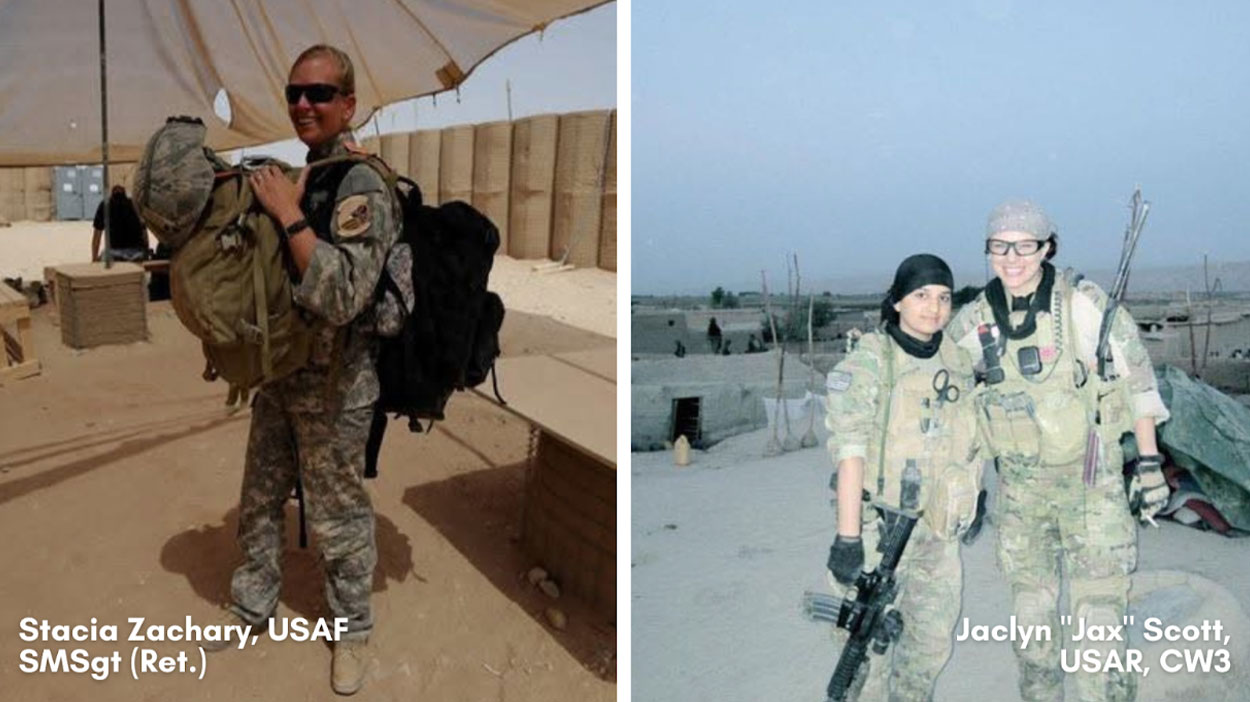
This Women’s History Month, we are sharing the perspectives of two extraordinary women veterans:
Stacia Zachary, USAF SMSgt (Ret.), Public Affairs and Combat Correspondent, and
Jaclyn “Jax” Scott, Chief Warrant Officer 3, currently serving in the 75th Innovation Command as a Cyber and AI Warrant.
Their service paths were different. Their experiences were unique. But when it came to navigating the VA disability system, their stories reveal strikingly similar challenges: being questioned, being minimized, and having to fight to be believed.
This piece speaks honestly about the unique barriers women veterans face when filing VA disability claims, how those barriers show up during evaluations and appeals, and how POVAT helps bridge those gaps through one-on-one advocacy.
Because the system does not always work the same for women.
The Story of Women Who Serve Is Often Overlooked
Stacia puts it plainly:
My story illustrates how Project OVAT is doing more than just helping veterans with claims; it is giving voice to a generation of women whose experiences have rarely been chronicled in history.
For centuries, we have understood the narrative of men who serve. But as Stacia explains:
For centuries, our culture has understood the narrative of men who serve: the son who leaves his family, the father who misses milestones, the soldier who goes to war. But the story of the female veteran, the daughter, the sister, the mother, has often been relegated to the margins.
That marginalization doesn’t stop when the uniform comes off. It often continues inside the VA system.
Stacia shares:
I do not want or seek recognition, but a reflection and understanding that the stories of women who serve are often forgotten, unheard, or unknown because silence is often easier than the questioning, doubt, and judgment that follows.
That questioning, that doubt, and that judgment are barriers women veterans face long before a rating decision is made.
When Service Doesn’t Fit the Narrative
Jax’s experience highlights another layer of difficulty: proving combat service that wasn’t formally acknowledged at the time.
She says:
I used to be super positive about it and tell women to trust the process. But after years of struggling and simply getting older, I am much more direct. I would tell them that the process will be more challenging for them because they are women. They need to ensure they have all their documentation, and the more the better for every single claim. Do not listen to how men navigate it; their process is much different and significantly easier. Be prepared to justify every single scrape, bruise, and injury.
For women who served in combat roles before official policy changes, documentation alone often isn’t enough.
Jax explains:
Constantly having to justify and explain that I went to combat, that my injuries are combat-related, and exactly what a Cultural Support Team (CST) was and why it matters to my claim.
She describes the exhaustion of repeated TBI evaluations:
Going through multiple TBI evaluations was exhausting. During one of them, I just lost it on the doctor. I skipped right past the assessment and went straight to frustration, asking why he couldn’t just look at my records. Having to go through that evaluation for the fourth time in one year, and still not being able to file a claim for my TBI, was profoundly demoralizing. I was so tired of it. After that appointment, I just sat on the floor at my house and cried. I was exhausted and felt completely defeated.
And she adds:
Trust us when we say we were in combat. The VA trusts men by default when they say it; they need to start trusting their women service members just as much.
The system often relies on job descriptions and DD-214s that fail to capture the full scope of women’s service.
As Jax says:
The VA needs to stop trying to write our medical narrative by looking only at our military job description and DD-214, much of which does not provide data on our combat deployments. Therefore, they need to sit, listen, and trust us more.
The Unspoken Sacrifices of Mothers in Uniform
Stacia’s story adds another dimension: motherhood in uniform.
My experience as a young mother in the Air Force is a stark and crucial narrative.
She shares the timeline plainly:
- 7 weeks after birth: Given a deployment tasking.
- 2 months postpartum: Ordered to cease breastfeeding for training.
- 4 months postpartum: I left my daughter, missing her first words and her first crawl, to train for two months.
- 8 months to 14 months postpartum: I deployed to Kabul, Afghanistan, serving outside the wire, and my husband (a USAF combat controller) also deployed two weeks before my departure.
And the reality few people talk about:
The reality of our situation was that we needed to plan for who would raise our daughter while we were both deployed, and also have a plan for who would raise her if we did not return…that is the gut-wrenching reality of what dual-military families face, especially then.
When Stacia came home:
My homecoming was not a simple reunion, but a painful collision of duty and motherhood. She was terrified by me, and I was terrified of being a mom. I forgot how to love and connect and was scared of failing. I also had to put the horrible things that happen in war, the death, the suffering and the things we had to do, in a box. I had changed so much, I was no longer that happy and carefree girl. Instead, I was a stronger, harder version who couldn’t reconcile the two very separate sides of myself.
These experiences shape mental health, stress, and trauma, but they are rarely acknowledged fully in the disability narrative.
The Pain of Being Dismissed
Women are also often conditioned to minimize their pain.
Jax explains:
During your medical appointments, do not downplay anything. Women tend to suck it up, and doing so can negatively impact our ratings. Don’t lie, but absolutely do not underplay it. Women typically have a higher pain threshold than men, and we tend to downplay everything because we do not want to be seen as weak… so a pain scale of 6 is almost always an 8.
The habit of endurance, once a survival tool, can become a liability in the claims process.
And when disbelief is layered on top of that, it becomes devastating.
The Turning Point: Being Believed
For both women, the turning point wasn’t just paperwork; it was validation.
Jax says:
The moment I finally felt believed was when I started working with POVAT and the Special Operations Association of America (SOAA). Up to that point, most nonprofits would not help me. I tried reaching out to VSOs and was even willing to pay for help, but I just hit wall after wall after wall.
And:
POVAT made a difference by giving me my power back and giving me a voice. I felt more confident and prepared when going into my medical appointments.
For Stacia, the impact is generational:
In providing a platform where my story and Jax’s are believed and honored, Project OVAT serves as a crucial repository for the oral history of women in service, ensuring these vital experiences are not lost.
POVAT does more than file paperwork. They listen, they prepare, and they stand beside you.
One Veteran @ A Time.
A Call to Women Veterans
Stacia says:
I hope my story is a call for action among female veterans. We need to highlight the importance of fellow service sisters, that there are other women out there who know the hard and ugly parts of serving.
And:
By sharing my story, I want the mothers, sisters, daughters, and friends who serve honorably to be seen and cared for in a similar light to the men who do.
Women veterans do not need special treatment. They need to be trusted, validated, and given equal recognition.
And when the system falls short, they deserve someone who will stand in their corner. At Project One Vet @ A Time, that is our promise.
